
The “Biophilic Art” Trend in 2026: Natural, Organic Painting That Feels Like It’s Breathing
Over the past decade, art movements have undergone a dramatic shift—from the calm order of minimalism to the visual intensity of digital illustration, and ultimately to the explosive rise of AI-generated imagery.
But entering 2025–2026, a clear counter-movement has emerged across the Western art world: a return to naturalness, materiality, and bodily presence in visual expression.
One of the most important manifestations of this shift is the growing popularity of Biophilic Art (also called Organic Painting).
It is not a strict art movement with fixed rules. Instead, it is a shared visual and emotional direction:
artworks that feel alive, as if they are breathing, growing, and evolving.

1.What Is Biophilic Art?
Biophilic art refers to a painting style inspired by natural forms, biological systems, and organic textures.
Its key characteristics include:
- Curved forms dominate over straight lines
- Structures resemble cells, plants, minerals, or flowing water
- Color palettes are grounded in nature (earth tones, moss greens, mineral blues, sunset oranges)
- No rigid symmetry—composition feels “grown” rather than designed
- Strong emphasis on flow, transformation, and emergence
You can think of it as a visual ecosystem rather than a static image.
While the concept is not entirely new, in 2026 it has gained renewed meaning as a response to digital saturation and AI-generated visual fatigue.

2.Why Is Biophilic Art Trending in 2026?
The Backlash Against AI-Generated Imagery
With the rapid rise of AI image tools in recent years, visuals have become:
- Technically perfect but emotionally flat
- Highly complex but lacking physical presence
- Visually polished but missing human imperfection
As a result, both audiences and collectors are beginning to ask for something different:
“We want to see human traces, not algorithmic perfection.”
Biophilic art answers this demand by embracing irregularity, texture, and physical imperfection.
Interior Design Is Driving Art Preferences
Contemporary Western interior design strongly emphasizes healing and nature-integrated spaces, often referred to as “wellness interiors”.
Common elements include:
- Wood, stone, linen, and natural materials
- Soft natural lighting
- Indoor plants as focal points
- Airy, breathable spatial layouts
In such environments, sharp geometric abstraction or overly digital aesthetics often feel visually “harsh.”
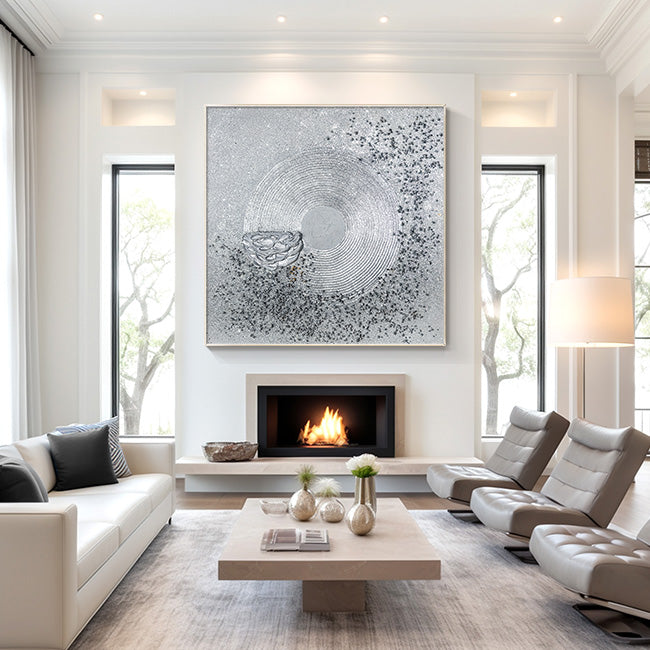
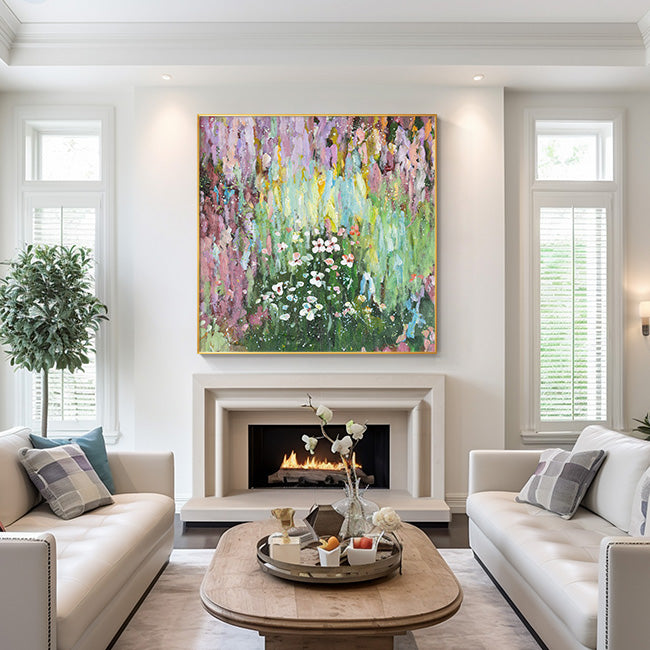
Organic paintings, on the other hand, integrate seamlessly into these spaces and often feel like an extension of the environment itself.

Psychological Demand for Nature Reconnection
Modern urban life has created widespread sensory fatigue.
Research in environmental psychology often refers to the Attention Restoration Theory, which suggests that:
Natural patterns help the human brain recover focus and emotional balance.
Natural visual elements such as:
- Flowing water
- Leaf structures
- Cloud formations
- Geological textures
naturally evoke calmness and mental restoration.
Biophilic art translates these biological calming systems into visual form.

3. The Core Visual Language of Biophilic Art
To understand or create this style, it helps to break it down into four essential dimensions:
Structure: From Composition to Growth
Traditional painting focuses on balanced composition.
Biophilic art behaves more like a living system:
- Growth pathways like plants
- Cellular division patterns
- Fluid expansion like water currents
The artwork is not “designed”—it feels grown.
Linework: Rejecting Mechanical Straight Lines
In this style, lines are almost always:
- Curved
- Irregular
- Slightly unstable
This controlled unpredictability is what gives the work its sense of life.

Color: Low-Saturation Natural Systems
Typical palettes include:
- Soil brown + misty white
- Moss green + limestone gray
- Deep ocean blue + muted gold
- Sunset orange + soft skin tones
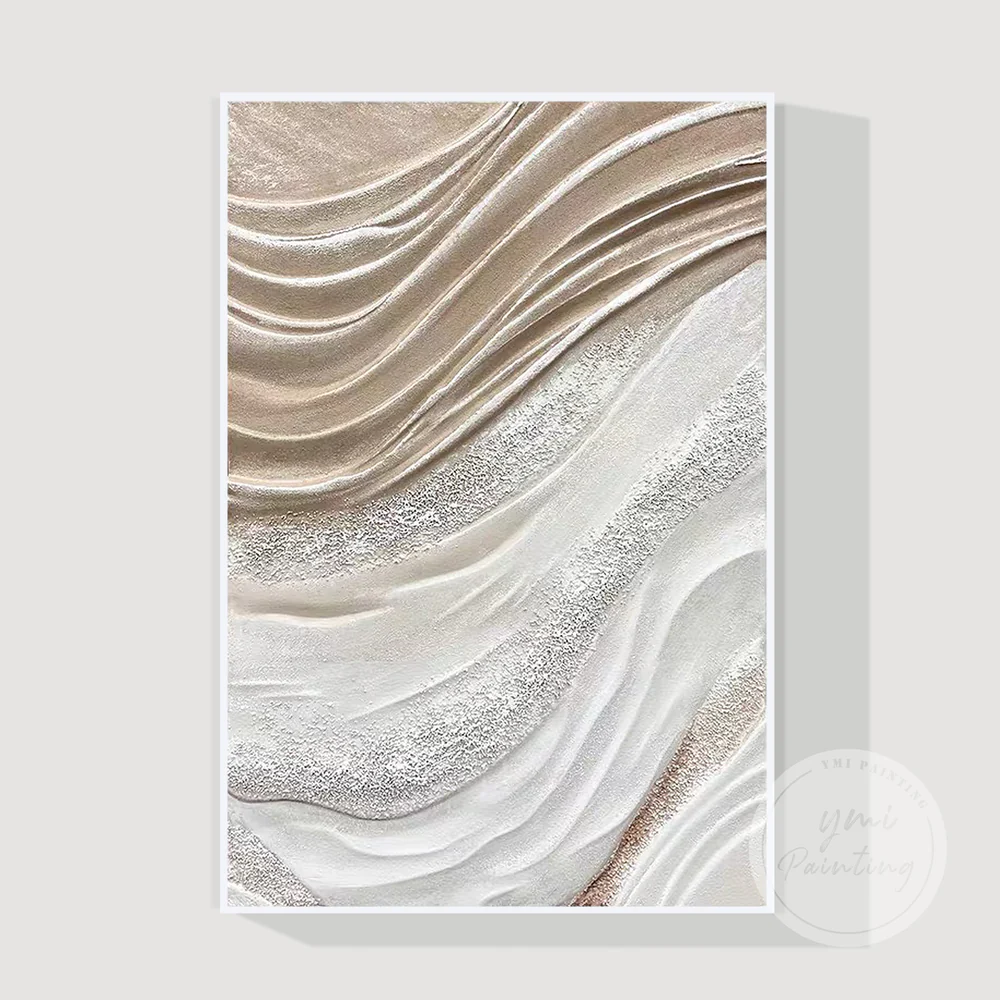
Texture: Material Over Image
Many artists are increasingly using:
- Thick paint layering
- Mixed materials like sand or ash
- Paper fiber textures
- Fragmented or eroded surfaces
The intention is to make the artwork feel like a physical object, not just an image.

4. Texture: Material Over Image
Many artists are increasingly using:
- Thick paint layering
- Mixed materials like sand or ash
- Paper fiber textures
- Fragmented or eroded surfaces
The intention is to make the artwork feel like a physical object, not just an image.
4. Why This Style Works for Independent Artists
For independent creators, biophilic art offers a major advantage:
👉 It is not easily standardized
While AI can replicate styles, it struggles to reproduce:
- Gesture-based spontaneity
- Material unpredictability
- Physical interaction with medium
This makes it easier for artists to build a recognizable personal identity.
👉 It is ideal for series-based work
This style naturally lends itself to thematic collections such as:
- Memory of Urban Plants
- Underwater Structures
- Shapes of Wind
- Cells and Cosmos
Each series can explore biological or environmental metaphors.
👉 It works across multiple mediums
Biophilic aesthetics are not limited to painting. They extend to:
- Digital illustration
- Murals
- Ceramic surfaces
- Textile design
- AI-assisted mixed media works

5. How to Start Creating Biophilic Art
If you want to experiment with this style, here are three practical steps:
Step 1: Observe Nature Instead of Art References
Focus on real natural systems:
- How roots branch underground
- How water flows around obstacles
- How clouds diffuse in the sky
- How rocks fracture over time
The goal is to understand growth logic, not visual imitation.
Step 2: Limit Straight Lines and Rigid Composition
Set a simple rule:
No more than 3 straight lines in one artwork
This immediately pushes your composition toward organic movement.
Step 3: Allow Controlled Unpredictability
Do not over-control the outcome.
Many of the most compelling organic textures come from:
- Paint diffusion
- Unexpected blending
- Layered imperfections
The key principle is:
Control half, and let the medium respond to the rest.
6. Future Directions of Biophilic Art
Looking ahead, biophilic art may evolve into three major directions:
1. Hybrid AI + Handcrafted Organic Art
AI-generated structures refined through human tactile intervention.
2. Immersive Environmental Art
Artworks expanding beyond canvas into spatial installations.
3. Functional Design Integration
Applied in architecture, branding systems, and product textures.
Conclusion
The rise of biophilic art is not just a stylistic trend—it reflects a deeper cultural shift.
In an increasingly digital and algorithm-driven world, people are rediscovering the value of:
What cannot be fully calculated, replicated, or optimized.
Biophilic art is not about depicting something accurately.
It is about expressing how life feels when it grows, moves, and breathes.If the dominant theme of the past decade was digital transformation, then the emerging theme of 2026 may be:
Organic perception, sensory presence, and reconnection with nature.